Salinas
Senza sangueSalinas’s defining contradiction is between his claimed reluctance to use weapons and the violence through which he confronts Manuel Roca. A former intelligence worker, he describes the war as something he fought at a desk, yet its final day left him with a memory of shooting his own brother that shapes his confrontation with Roca years later.
Identity and Wartime Past
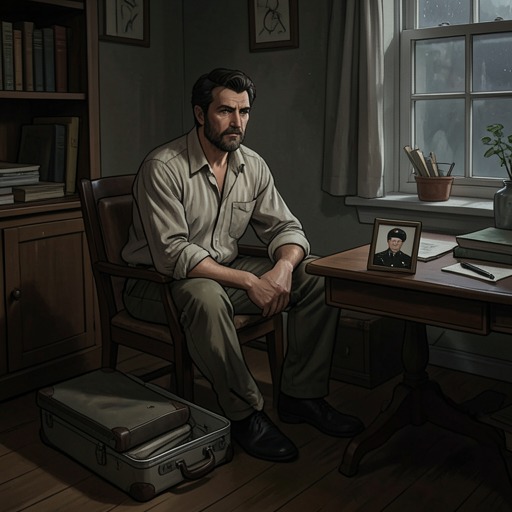
During four years of war, Salinas says, he worked at a desk rather than as a habitual gunman. He decoded enemy messages and planted spies among his opponents, who despised him and called him Salinas the Rat. He claims to have fired only twice: once into the darkness at no one, and once on the last day of the war, when he shot his brother. The contrast between this covert, administrative role and the intimate violence of his second shot defines the history he brings into the scene with Roca.
The Hospital Memory
Salinas recounts the memory that gives his second shot its unbearable weight. On the war’s final day, he and his companions entered a hospital before the army arrived, intending to kill the people they believed they had come to liberate. Manuel Roca and the other persecutors had already fled, leaving the hospital as it was: beds everywhere, even in the corridors, and patients too weakened to make a sound. Salinas remembers that silence as something he would hear every night for the rest of his life. The patients, he says, no longer wanted rescue; they wanted to die as soon as possible.
In the hospital chapel, Salinas found his brother lying among the others. His brother stared at him without recognition, barely breathing, and after Salinas pleaded with him to respond, slowly asked to be killed. Salinas says he promised instead to take him away and care for him, then identifies this as the occasion on which he shot his brother. The account places his wartime claim of having fired only twice beside a scene in which liberation arrives too late to be welcomed: the brother’s plea makes Salinas’s final-day shot not a battlefield act but an intimate response to suffering he could neither undo nor readily bear.
Confrontation with Manuel Roca
Salinas turns the encounter with Manuel Roca into a threat of disappearance. When Roca warns that they will all be arrested and spend their lives in prison, Salinas laughs while el Gurre watches. He then tells Roca to be quiet, draws a pistol from inside his jacket, and argues that nobody will ever learn what happened: Roca’s friends have abandoned him, Salinas’s own associates are occupied, and killing Roca would suit everyone. Roca calls them mad, but Salinas answers by cocking the weapon and insisting that Roca is finished.
The threat becomes an act of violence when Salinas presses the barrel against one of Roca’s knees and fires. Roca falls backward, curls up on the floor, and screams. Standing over him with the pistol aimed at him, Salinas shouts that he is going to kill him. The scene’s observers sharpen its contrast: el Gurre steps forward, while the young man at the door remains silent. Salinas’s cream-colored suit is spattered with blood, and his shrill voice makes him seem to be crying or struggling to breathe as he continues to threaten Roca. The outburst is not composed military violence; it is a loss of control that turns the threatened execution into a spectacle, ending in the moment when those present hear an impossible voice speak softly.
Death and Unresolved Aftermath
Two years after the affair with Manuel Roca, Salinas was found dead in his bed one morning. The explanation given was a heart ailment, but another account soon circulated: his doctor, Astarte, had supposedly poisoned him a little at a time over several months, making his death a slow and terrible agony. An investigation followed but produced no conclusion, leaving the cause of Salinas’s death uncertain rather than confirmed. The doctor’s background gave the rumor a pointed context. During the war, Astarte had made money from Botran, a medicine for fevers and infections that he developed with the help of pharmacist Ricardo Uribe. Salinas’s ending thus returns the story to the war’s aftermath and its unresolved accusations: even his final illness is described through competing explanations, with no inquiry able to establish the truth.